TechStrat Q3 M&A Update – The Buyer Has Changed
Strategic Fit Is Mandatory for AI-Era M&A
Headline M&A activity has improved in 2026, but many companies are being left behind. Large strategic transactions account for much of the increase, while financial sponsors remain selective about new standalone platforms. PE-backed operating companies, however, continue to acquireas they try and update their operating profiles to facilitate their own exits.
WHAT MATTERS: The shift is from standalone financial underwriting toward operating-company value creation. Sellers must show why the business is worth more inside a particular buyer than it is on its own.
1. Operating buyers are leading
FTI Consulting estimates that strategic buyers accounted for approximately 82.5% of global deal activity in Q1. Bain reports that total M&A value rose 41% through May, with strategic M&A up 36% while financial-investor deal value declined 9%. In software, SEG reports that direct PE platform acquisitions represented only 6.3% of Q2 SaaS transactions – although PE – and venture-backed buyers still participated in 59% of deals overall.
The exit bottleneck helps explain the split. PitchBook data cited by The New York Times show 33,575 unsold PE portfolio companies as of June 30, 2026, up from 32,451 at year-end 2025 and 15,923 a decade earlier. Higher borrowing costs, valuation gaps and weaker sponsor-to-sponsor demand are slowing exits. Deal activity has recovered faster than portfolio-company sales, encouraging sponsors to deploy through existing platforms and add-ons while remaining cautious on new platforms.
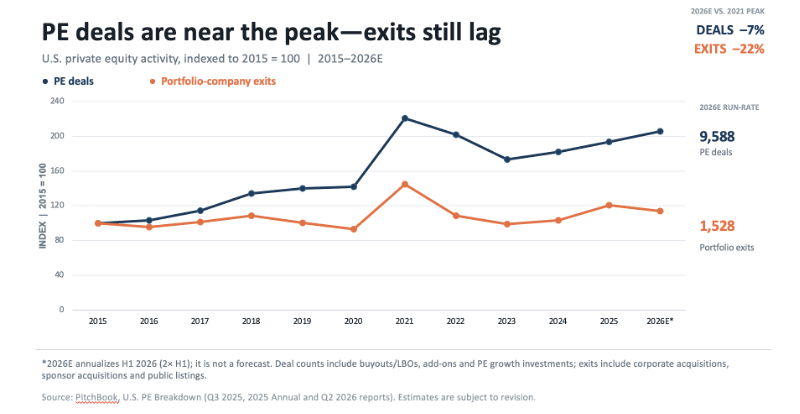
Figure 1. PE deployment has recovered faster than portfolio-company exits.
TechStrat’s own transactions point in the same direction. Across 41 transactions reviewed, 32 went to operating buyers – 27 pure strategic acquirers and five PE-backed strategic platforms – while nine went directly to financial buyers. We are selling companies by identifying strategic fit, and future opportunities, while helping clients shape their operating profiles to support a successful transaction.
2. AI is repricing what software is worth
One of our clients built a roughly $25 million revenue SaaS business over 14 years. Earlier this year, the CEO attended an AI hackathon and largely recreated the core functionality over a weekend. The lesson is not that software has stopped being valuable; it is that functionality alone is becoming easier and cheaper to create and deploy.
The Wall Street Journal has described a developing “SaaSpocalypse” as generative AI shifts demand from software that helps employees complete tasks toward systems and agents that perform more of the work. At the same time, companies such as Von, Lantern and Gong show that substantial value can still be created by redesigning architecture, workflows and economics around AI rather than adding features to a legacy product.
POSITIONING SHIFT: Do not sell “a SaaS company with AI features.” Sell an asset that owns valuable data, durable customer access and critical workflows – with AI as the lever that makes those assets more useful, scalable and defensible.
- Data and domain advantage. Show what proprietary or permissioned data, rules, integrations and operating knowledge the company controls.
- Customer and workflow durability. Demonstrate retention, depth of use, referenceability and the cost or risk of replacing the product.
- Measurable AI leverage. Tie AI to customer ROI, retention, pricing, implementation speed, service cost or gross margin – not feature count.
We do not expect the application market to become winner-takes-all. As cloud infrastructure enabled a new generation of independent software companies, foundation models and open-source alternatives should enable specialized, AI-aware vendors. The durable winners will combine those tools with proprietary data, embedded workflows, customer trust and efficient economics.
3. Strategic buyers require a tighter synergy case
The old formulation – “we can cross-sell into the buyer’s customer base” – is no longer enough. A credible case must answer five questions:
- Source of value. Which revenue, cost, capital or risk benefits will the combination create?
- Buyer-specific fit. Why is this target more valuable to this buyer than to the market generally?
- Timing. What can be captured in the first 100 days, the first year and thereafter?
- Cost and friction. What integration expense, product work, customer risk or organizational change is required?
- AI moat. How difficult would it be for a model or AI-native competitor to replicate the product, data, workflow and customer position?
PwC found that large acquirers that both announced and reported synergies materially outperformed silent acquirers over three years. McKinsey similarly emphasizes bottom-up plans owned by leadership. For a midmarket seller, the implication is simple: the value-creation story must be specific enough to survive an investment committee and practical enough to become an integration plan.
4. This is a selective market – not a closed one
Valuation dispersion has widened. Companies relying on historical SaaS multiples, generic functionality or financial engineering face pressure, while strategically scarce assets can still command strong outcomes. Many PE-owned sellers can also wait, combine portfolio companies, pursue continuation vehicles or hold longer, which further reduces forced transactions. Quality, differentiation and strategic relevance matter more than headline deal statistics suggest.
5. What sellers should do now
- Reframe the category. Lead with the customer problem, data asset, workflow position and strategic capability.
- Build the buyer map from adjacencies. Identify who will value your customers, data, distribution, and who needs to fill a product gap with your offering.
- Quantify the synergy case. Develop buyer-specific hypotheses with timing, investment requirements, and economic impact.
- Pressure-test AI defensibility. Document data rights, model dependence, inference economics, governance and production outcomes.
- Prepare before outreach. Resolve financial, legal, IP, customer and product issues before buyers can use them to reduce price or certainty.
During hype cycles we sometimes forget that technology isn’t the point – creating value for the customer is. AI is just another tool for delivering value.
6. Recent TechStrat Case Studies
Our recent transactions illustrate several of the characteristics we believe are becoming increasingly important.
Proprietary and Alternate Data
- Insight Energy – A leader in predictive analytics for the U.S. energy market, aggregating and distilling energy data from all 50 states. Its strategic value is rooted not merely in software functionality, but in the breadth and usefulness of the underlying data asset.
- MBS Source – A leading provider of securities data to the fixed-income market. The strategic opportunity lies in applying additional technology and AI capabilities to a difficult-to-reproduce information asset.
- Newslever – A competitive analytics platform that allowed enterprises to monitor their competitive environments through a single pane of glass. The combination with Similarweb creates opportunities to apply broader data and AI capabilities to an established enterprise workflow.
Domain-Specific Workflow Automation
- Undisclosed telematics transaction – A leading telematics provider serving CPG, energy and utility customers was sold in Q3 2026 to a strategic acquirer. Over nine years, the company had invested in specialized applications that automated discrete customer processes and delivered measurable ROI. A prior add-on acquisition also expanded its data footprint.The transaction illustrates an increasingly important principle: specialized workflow automation, proprietary data and customer entrenchment can remain highly valuable even as the cost of creating generic software falls.
Human Capital and AI Talent
- Cognits – An outsourced software-development company that repositioned itself during the sale process around recruiting and supplying AI talent in Latin America. The transformation demonstrated how an existing customer base, operating infrastructure and talent network could be reframed around a more strategically valuable market need.
Embedded, Sticky Workflows
- Urgent – A leader in asset-management solutions for mobility retailers, with deeply embedded positions inside several global retail chains. The company’s strategic relevance derives in part from its position within critical customer workflows – exactly the kind of embedded access that is difficult for a new entrant to reproduce quickly.
7. Why the advisor matters more now
A generic process built around backward-looking SaaS comparables can miss the buyers able to pay for synergies – and fail to give those buyers the concise, credible case they need to secure internal approval.
This is where TechStrat’s domain focus matters. We understand software, data, AI and tech-enabled services; the buyer organizations behind them; and the operating, legal, financial and negotiating issues that determine whether a midmarket transaction closes.
If an exit, recapitalization or strategic transaction may be on your 12- to 24-month horizon, the highest-leverage work begins before the first buyer call: defining the buyer universe, strengthening AI-era positioning, resolving diligence issues and building the synergy case.
Recent conversations from TechStrat
Nat Burgess and Michael Bolotin have discussed these themes in recent podcasts and interviews:
- The Impact of AI on Startup Exits;
- The Future of Tech M&A: What Most Investors Miss;
- Technology M&A in Today’s Market;
- The Future of Work: Embracing AI While Cultivating Human Creativity;
- AI, M&A and the Future of Tech Deals.
Please reach out if you are leading, investing in, buying or advising a software or tech-enabled services company and would like to discuss how these shifts apply to your situation.
Sources referenced in this update include: FTI Consulting, Bain & Company, Software Equity Group, PitchBook data cited by The New York Times, The Wall Street Journal, PwC, and McKinsey & Company.